
Industrial Rope Access vs Recreational Rock Climbing: Key Differences
Think rope access is just rock climbing with a hard hat? Think again. We break down the real differences between industrial rope access and recreational climbing — equipment, techniques, safety standards, and career implications.
"So you're basically a rock climber?"
Every rope access technician has heard this. And while the question makes sense from the outside — both involve ropes and heights — the reality is that industrial rope access and recreational rock climbing are fundamentally different disciplines.
Understanding these differences matters whether you're a climber considering rope access as a career, an employer trying to understand the industry, or a technician tired of explaining what you actually do.
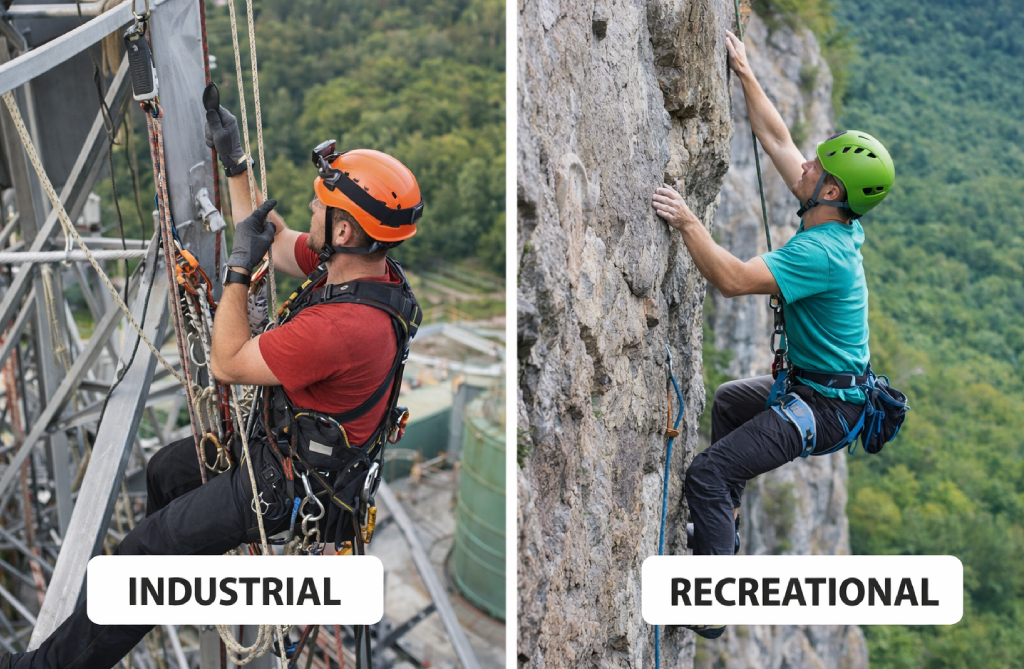
The Fundamental Difference: Purpose
This is the root of everything else.
Recreational climbing exists for the experience itself. The goal is to climb — for sport, for challenge, for enjoyment. The climb IS the point.
Industrial rope access uses ropes as a method to reach a work location. The ropes aren't the point — they're the transport system. The actual work (inspection, welding, painting, maintenance) is the point.
This distinction drives every other difference in equipment, technique, safety approach, and mindset.
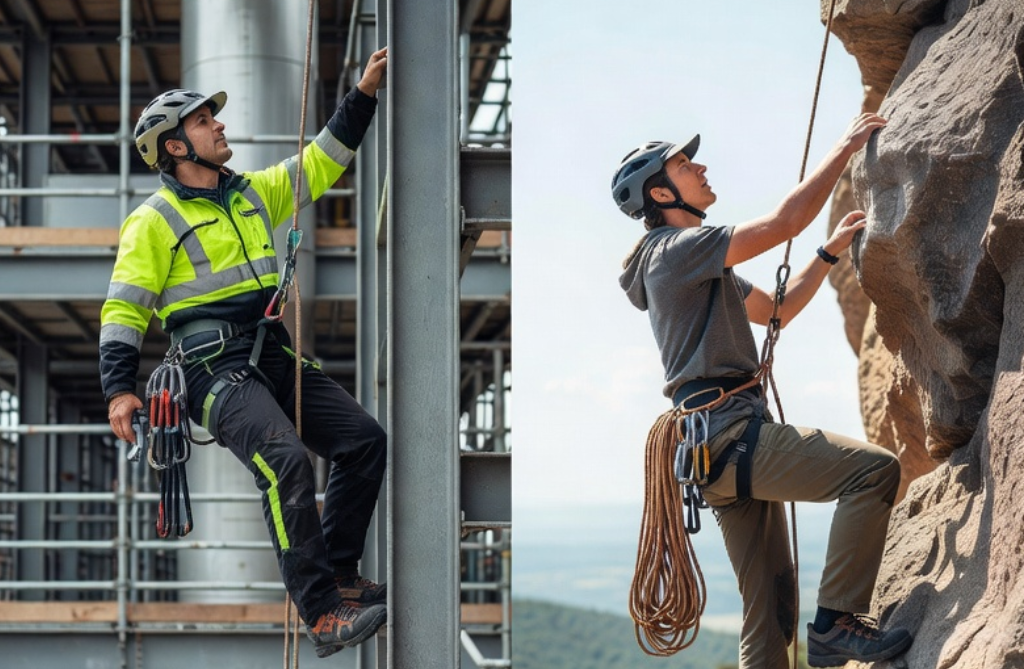
Equipment Differences
Ropes
- Dynamic ropes (stretch to absorb fall energy)
- Single rope: 9-10mm diameter typically
- Designed to catch lead falls with significant fall factors
- Elasticity is a feature, not a bug
- Semi-static (low-stretch) ropes (EN 1891 Type A)
- 10-11mm diameter typically
- Minimal stretch for precise positioning
- TWO ropes always — working line + safety line
- Dynamic ropes used only in specific rescue scenarios
Why low-stretch? When you're positioning yourself to weld a bracket at exactly the right height, you don't want your rope bouncing you up and down every time you shift weight. Precision positioning requires minimal stretch.
Harnesses
- Lightweight sit harness
- Designed for upward movement and fall catching
- Minimal gear loops
- Comfort during climbing motion
- Full sit harness with chest harness attachment
- Designed for prolonged suspension (hours, not minutes)
- Multiple attachment points (front, rear, side, sternal)
- Heavy-duty construction for industrial environments
- Extensive gear loops for tools and equipment
- EN 361 + EN 813 certified
A climbing harness would be dangerously uncomfortable and functionally inadequate for a full day of rope access work. Conversely, a rope access harness would feel absurdly heavy and restrictive for sport climbing.
Descent Devices
- Belay devices (ATC, GriGri) used for controlled descent
- Often abseiling is a quick way to get down after a climb
- Speed and simplicity valued
- Purpose-built descenders (Petzl ID, RIG, or equivalent)
- Anti-panic function (locks if you panic-grip)
- Designed for smooth, controlled, hands-free stopping
- Must allow precise positioning at any point
- Self-braking is standard
Backup Systems
- Single rope system is standard
- Belayer provides the backup
- Protection (quickdraws, cams, nuts) placed along the route
- System relies on human belayer attention
- Mandatory second independent system (safety line)
- Mechanical backup device (e.g., Petzl ASAP) on safety rope
- No human element in the backup — it's mechanical and automatic
- Both systems anchored independently
This is perhaps the biggest difference. In climbing, if your belayer gets distracted, you could fall. In rope access, if your working line completely fails, the independent safety line catches you without any human intervention needed.
Technique Differences
Movement
- Free climbing: using hands and feet on rock
- Movement is the skill — efficiency, technique, strength
- Ascending is the challenge
- Different styles: bouldering, sport, trad, multi-pitch
- Ascending and descending using mechanical devices on ropes
- Movement is a means to an end — get to the work position
- Efficiency valued, but technique is standardized
- Aid climbing concepts (ascending using rope, not rock features)
A talented rock climber might struggle initially with rope access techniques because the skills don't fully transfer. The movement patterns, device manipulation, and rope handling are quite different from free climbing.
Anchoring
- Natural features (cracks, threads)
- Removable protection (cams, nuts)
- Fixed anchors (bolts) on sport routes
- Anchor building is a key climbing skill
- Engineered anchor points where possible
- Structural connections to buildings, platforms, steelwork
- Load calculations and safety factors applied
- TWO independent anchors minimum (one per rope)
- Anchor assessment by Level 3 supervisor
In climbing, anchor building can involve creative problem-solving with available features. In rope access, anchoring follows engineering principles with defined safety factors. The standard is higher because the consequences affect not just you but potentially the public below.
Positioning
- You move to where you want to be using body movement
- Rest positions are natural stances or hanging on gear
- Position is temporary — you're passing through
- You position yourself precisely at a work location
- Remain stationary for extended periods
- May need hands-free positioning to use tools
- Work positioning devices and techniques for stability
- Adjust position by millimeters to reach exactly the right spot
Rope access requires the ability to be comfortable and productive while suspended for hours. Climbing requires bursts of intense effort followed by rest.
Safety Standards
This is where the gap is enormous.
Rock Climbing Safety
- Personal responsibility and judgment
- Peer education and mentor relationships
- Published guidelines from climbing organizations
- Equipment must meet EN/UIAA standards
- No formal certification required to climb
- Accidents happen and are accepted as inherent risk
Climbing accepts a level of risk. That's part of the culture — calculated risk management is a personal skill, and experienced climbers make judgment calls constantly.
Rope Access Safety
- Formal certification required (IRATA/SPRAT)
- Written method statements for every job
- Risk assessments before work begins
- Rescue plans mandatory
- Equipment inspection regimes (daily + periodic)
- Work supervised by Level 3 at all times
- Near-miss reporting systems
- Industry-wide safety statistics tracked and published
- Regular audits of member companies
The rope access industry cannot accept the risk tolerance of recreational climbing. If a climber falls and is injured, it's a personal tragedy. If a rope access technician falls onto a public street, it's an industrial incident with legal, regulatory, and public safety implications.
IRATA publishes annual safety statistics showing that the rope access industry maintains one of the lowest incident rates of any work-at-height method. This isn't by accident — it's the result of systematic safety management.
Physical and Mental Demands
Rock Climbing
- Upper body and finger strength crucial
- Power-to-weight ratio matters
- Flexibility and reach
- Endurance for sustained climbing
- Peak physical performance often valued
- Route reading and problem-solving
- Fear management
- Flow state during climbing
- Risk assessment in real-time
Rope Access
- General fitness and stamina (full day suspended)
- Comfortable with heights (but managed differently)
- Ability to work physically while suspended (using tools, lifting)
- Core strength for prolonged sitting in harness
- Resistance to discomfort (harnesses aren't comfortable for 8+ hours)
- Task focus (the actual trade work is the mental challenge)
- Safety awareness at all times
- Patience (some tasks are repetitive)
- Professional judgment about conditions and safety
- Communication with team members
Rope access values consistency and professionalism over athletic performance. You don't need to be a world-class athlete to be an excellent rope access technician, but you do need to be reliably competent day after day.
Can Climbers Transition to Rope Access?
Yes, and many do. But it's not automatic.
Advantages Climbers Bring
- Comfort at height (usually)
- Basic understanding of rope systems
- Experience with knots and anchoring concepts
- Physical fitness for working at height
- Comfort with exposure
What Climbers Need to Learn
- Completely different equipment and techniques
- Industrial safety mindset (not personal risk tolerance)
- Formal procedures and documentation
- Trade skills (the actual work, not just the access)
- Working as part of a supervised team
- Standardized methods vs creative problem-solving
Common Adjustment Challenges
Pace: Climbers are used to moving efficiently. Rope access work often involves slow, methodical positioning and long periods of stationary work.
Risk tolerance: Climbers may be comfortable with risk levels that are unacceptable in industrial settings. The shift to zero-risk-tolerance culture requires adjustment.
Independence vs team: Many climbers value independence. Rope access always involves teamwork and supervision.
Following procedures: The creative problem-solving valued in climbing needs to be channeled into following established methods in rope access.
The Path
- Complete IRATA Level 1 training (your climbing experience helps but doesn't replace it)
- Understand that rope access is a new discipline, not an extension of climbing
- Develop or demonstrate a trade skill (what will you DO at the work position?)
- Build hours and progress through levels
Climbing experience is helpful background, but it's the starting line, not the finish.
Career Comparison
Rock Climbing Careers
- Sponsored athlete / professional climber
- Climbing instructor or guide
- Route setter (indoor climbing)
- Climbing coach
- Outdoor education instructor
- Climbing wall management
These are generally passion-driven careers with moderate earning potential (with exceptions for top athletes).
Rope Access Careers
- Rope access technician (various specializations)
- Supervisor (Level 3)
- Inspector (with NDT qualifications)
- Rope access trainer/assessor
- Operations/project management
Rope access offers stronger earning potential: €150-600+ per day depending on level, skills, and sector. It's a skilled trade career that can provide excellent income with flexibility.
For more on rope access earnings, see our salary guide.
Can You Do Both?
Absolutely. Many rope access technicians are recreational climbers in their time off. The skills and interests are complementary even if the disciplines are different.
- Better rope handling skills
- Improved rescue capability
- Greater comfort with equipment systems
- Different perspective on heights and exposure
And climbing keeps you fit and motivated, which helps with rope access work.
Summary
| Aspect | Rock Climbing | Rope Access |
|---|---|---|
| Purpose | The climb itself | Access to work location |
| Ropes | Single dynamic | Two semi-static |
| Backup | Human belayer | Mechanical device |
| Safety | Self-regulated | Formally certified |
| Movement | Free climbing skill | Mechanical device operation |
| Duration | Minutes to hours of climbing | Full workday suspended |
| Documentation | Personal choice | Mandatory |
| Earning | Passion-driven | Skilled trade income |
Both are valid, skilled activities. They're just different — and understanding those differences helps whether you're considering the transition, explaining your job to relatives, or appreciating what rope access technicians actually do.
Interested in Rope Access?
If you're a climber thinking about rope access as a career, start by:
- Researching IRATA certification requirements
- Understanding the career path and earnings
- Considering what trade skill you'd bring to the industry
- Finding a reputable training center
Already certified? Join Rope Access Network and build your professional profile. Whether you came from climbing or from another trade, the platform connects you with employers looking for qualified technicians.
Have questions about transitioning from climbing to rope access? Reach out — many of us made that journey and are happy to share our experience.
Ready to Start Your Rope Access Career?
Join thousands of certified technicians on Rope Access Network. Create your professional profile, showcase your certifications, and connect with leading companies in the industry.